Housing Allowance or School Flat? How to Work Out What You'll Actually Keep
A chunky housing allowance looks brilliant on paper until you meet agency fees, four-cheque rules, and utility deposits. Here is how to work out which option leaves you with more in your pocket.

The staffroom dilemma: cash in hand vs peace of mind
When you're sat looking at an offer letter from an overseas school, an unbundled housing allowance often looks like the winning ticket. Seeing an extra 9,000 to 12,000 AED or QAR on top of your basic salary feels like serious purchasing power. You picture yourself picking your own stylish flat, choosing your favourite neighbourhood, and pocketing whatever's left over.
Talk to any teacher who has been out in the Middle East or Southeast Asia for a couple of years, though, and you'll hear a rather different story. What looked like a generous allowance on recruitment day can quickly turn into a headache once local estate agents get involved.
“An allowance set three years ago might look tidy on paper, but if local rents have jumped 20%, you'll end up dipping into your basic teaching salary just to pay the landlord.”
The hidden frictions of the private rental market
Taking the cash means stepping directly into the local private rental market, and that demands serious upfront cash from day one. In places like the UAE, Qatar, or Hong Kong, you aren't just paying monthly rent from your bank account:
- Estate agent commissions: usually 5% of the total annual rent plus VAT, straight out of your pocket.
- Security deposits: another 5% locked away until the day you leave the country.
- Post-dated rental cheques: landlords frequently want the entire year's rent in just 1 to 4 cheques, meaning you need local banking and hefty funds set up immediately.
- Utility hook-ups: connection fees and deposits for electricity, water, internet, and district cooling (chiller charges) that can swallow your first month's allowance entirely.
When does taking the cash allowance actually make sense?
Taking the cash allowance works well if you already have a partner whose school gives them a flat, or if you're genuinely happy to live further out along a metro line in a simpler one-bed. If you're keen to live in the expat bubble right next to the school, the school-provided flat almost always wins on pure savings and stress levels.
How we model this on Leopardfish Intel
This exact trade-off is why we built our Evaluate tool. When you pull up any school on Leopardfish Intel, you can toggle between 'Provided' housing and a cash 'Allowance'. We compare the allowance against real, up-to-date city rental averages and utility costs, showing you the exact difference in your Monthly Disposable Surplus.
It takes the guesswork out of the offer letter, so you can see whether taking the cash leaves you comfortable or counting every penny before you fly out.
- Cash allowances rarely keep pace with local rents in high-demand expat hubs like Dubai, Singapore, or Bangkok.
- School-provided accommodation protects you from estate agent fees (5%), deposit lock-ups, and painful four-cheque demands.
- Taking the cash only pays off if you're happy to downsize, commute that bit further, or move in with a partner.
- Always check who pays the municipality housing fees, district cooling bills, and water deposits before opting for cash.
Planning your next international move?
Run your net income and cost of living estimates through our financial model.
More Insights & Briefings
Continue exploring comparative analysis and field intelligence.
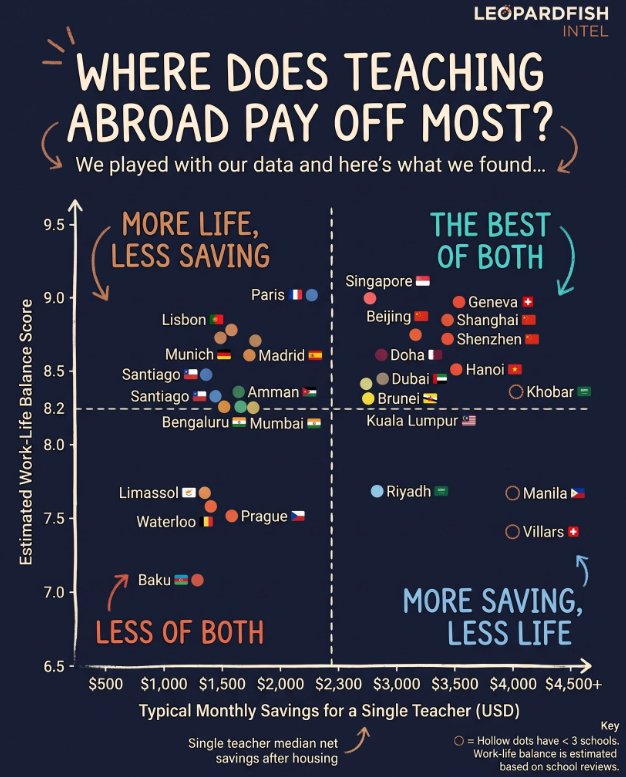
We Plotted 54 Global Teaching Hubs: What Teachers Actually Pocket vs Work-Life Balance
We plotted 54 international teaching hubs by what teachers actually pocket every month (savings after housing and living costs) vs estimated work-life balance. The breakdown tells a massive story across Europe, Asia, and the Gulf.

How Do You Get a Business Class Upgrade?
We've all walked through the business-class cabin wondering how people get those seats. But if your school gives you a flight allowance, the choices suddenly open up.

So, What Sort of Tipper Are You?
You're out for dinner, the food was good, and the bill arrives. Does how you handle the tip give away the kind of expat life you're planning?